Puppy Fear
Puppy Fear: Is This Normal Caution, or Something to Address?
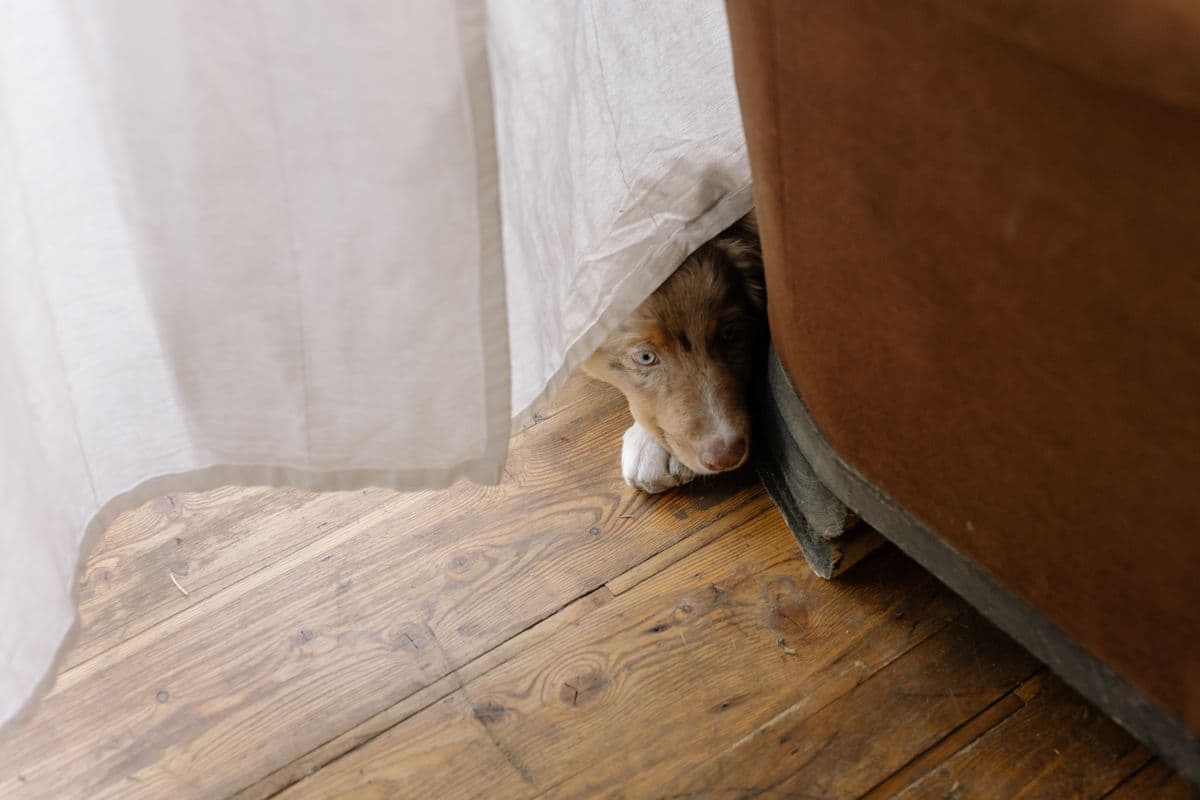
Quick answer
Brief hesitation or caution around something new is normal and doesn't need "fixing." Persistent avoidance, freezing, trying to escape, or fear that doesn't ease with a slow, positive approach is different and worth addressing — ideally without forcing exposure or waiting it out indefinitely. What changes the answer: how the response trends over repeated, gentle exposure — improving is normal caution; not improving, or worsening, is fear worth addressing directly.
Normal Caution vs. Concerning Fear
A puppy pausing, sniffing cautiously, or briefly hesitating before approaching something new is ordinary information-gathering, not fear. Signs that indicate genuine fear rather than normal caution include a body held low or stiff, tail tucked, "whale eye" (whites of the eyes showing), pinned-back ears, trembling, attempts to flee, or freezing in place rather than investigating.1 The key distinguishing factor isn't the presence of hesitation — it's whether your puppy recovers and re-engages with a little time and distance, or stays stuck.
What's Actually Known About "Fear Periods"
You'll see specific claims online — "the fear period is exactly weeks 8 to 11" — stated with more precision than the evidence actually supports. What's genuinely well established: the first roughly three to four months of life is a broad, important developmental window for socialization, during which negative or overwhelming experiences can have an outsized, lasting effect.2 What's less settled: sources describing a more specific "fear-sensitive" sub-period commonly reference something in the 8–11 week range, and a possible second period during adolescence — but not every puppy shows two distinct periods, and age alone can't confirm that a behavior change is developmental rather than caused by something else (a bad experience, an illness, an environmental change).3 We're not going to hand you a precise week-by-week fear-period calendar, because the evidence doesn't support one that precisely — what matters more than pinpointing a period is responding well whenever fear shows up.
When a Previously Confident Puppy Suddenly Seems Scared
This is genuinely common and doesn't necessarily mean anything is developmentally "wrong." Before assuming it's a fear-period-related phase, it's worth briefly considering: has anything changed (environment, routine, a recent scare)? Could there be a physical cause (pain, illness, discomfort can change how a puppy responds to things that didn't bother them before)? If nothing obvious explains it, treating it like any other fear response — patience, distance, gradual positive reintroduction, no forcing — is the right approach regardless of the underlying cause.
The General Response, Regardless of Cause
- Don't force continued exposure — increase distance instead.
- Pair the trigger with something positive, at a distance your puppy can stay calm at.
- Go slowly — rushing to "prove there's nothing to be afraid of" tends to backfire.
- If it's a specific, identifiable trigger (a type of person, other dogs, a sound), see the matching spoke page below for trigger-specific guidance.
Where to Go Next
| Situation | Go here |
|---|---|
| Puppy shows fear specifically around people | Puppy Fear: Scared of People |
| Puppy shows fear specifically around other dogs | Puppy Fear: Scared of Dogs |
| Puppy shows fear specifically of a sound | Puppy Fear: Scared of Noises |
| A known, specific bad event happened | Bad Experience |
| Proactively preventing fear before it develops | Puppy Socialization Checklist |
Want a response plan for your puppy?
Get a response plan matched to what your puppy is actually showing.
Common Mistakes
- Forcing exposure to "prove" there's nothing to fear — flooding.
- Assuming every hesitation is a sign of a problem.
- Diagnosing a specific developmental "fear period" with more precision than the evidence supports.
- Ignoring a sudden behavior change without considering a physical cause.
When Professional Help May Be Appropriate
Persistent fear that doesn't improve with a slow, positive approach; fear that seems to be spreading to new triggers; any sudden behavior change alongside signs of pain, illness, or discomfort — start with your veterinarian to rule out a physical cause before assuming it's purely developmental or behavioral.
Sources
- General fear-signal description consistent with veterinary behavior literature on canine fear body language (cross-referenced against VCA's fear-related content across this cluster)
- AVSAB, "Position Statement on Puppy Socialization"
- Documented range of professional/training-source descriptions of a "fear-sensitive" sub-period — presented as an honest range, not a settled fact