Puppy Biting
Puppy Biting: Why Puppies Bite and How to Stop It
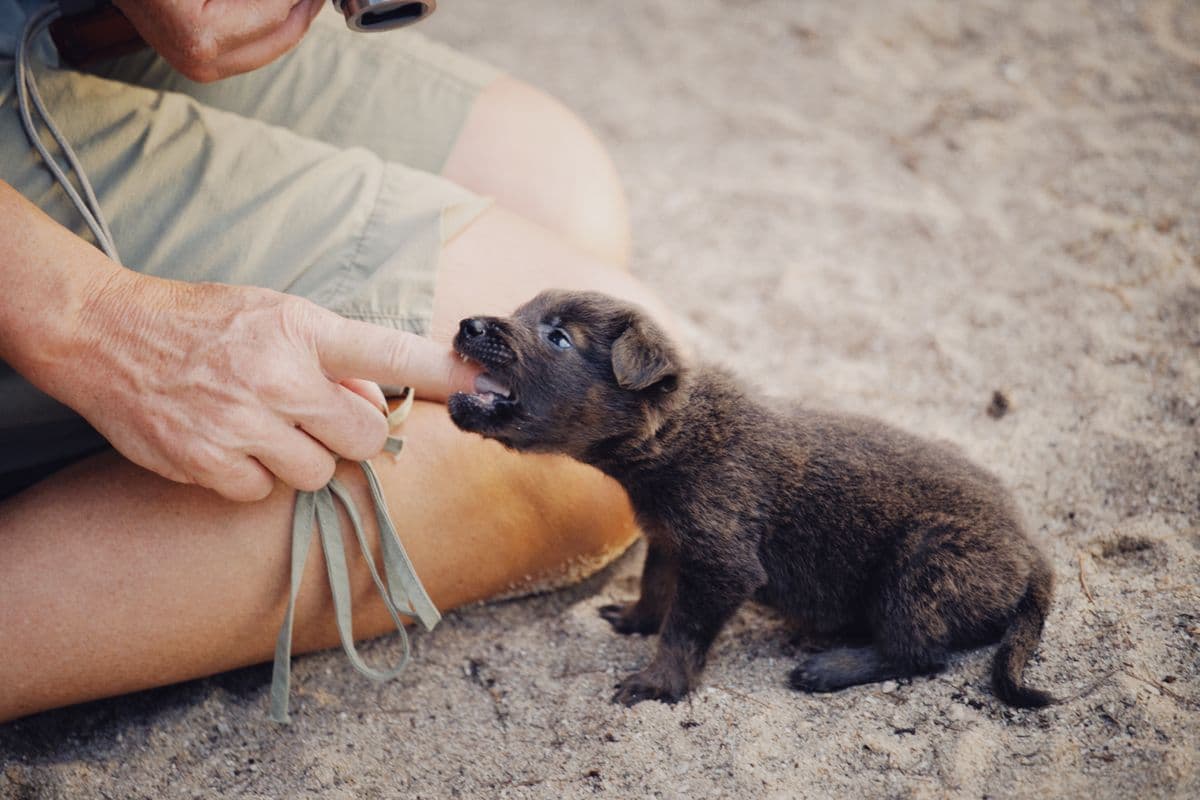
Puppy biting is normal. It's mostly a form of social play, not primarily a teething behavior — teething shows up more as gnawing on objects than as biting people.1 That doesn't make it pleasant to live with, but it does mean you're not dealing with a "bad" puppy — you're teaching a skill called bite inhibition: learning to control how hard the mouth closes.
The 60-Second Biting Response
The moment teeth touch skin or clothing:
- Stop moving and go still. This is the default, reliable first step — stopping the action removes the "game" instantly.
- Calmly disengage for about 10–20 seconds — stand up, turn away, or briefly step out of reach. Keep this quiet and unemotional.
- Redirect to an appropriate toy once things are calm — offer it before re-engaging, not as a chase.
- Resume calmly. If the puppy mouths gently, that's success — resume play. If teeth come out hard again, repeat the disengage step.
A note on sound: some guidance suggests adding a short "ow" or yelp to this sequence, mimicking how a puppy's littermates respond to a too-hard bite. This works for some puppies. For others, a vocal reaction is exciting rather than informative and actually escalates the biting.2 Because of that, going still and calmly disengaging — not vocalizing — is the more reliable default. If you want to try a brief yelp, watch how your specific puppy responds: if it makes things more intense, drop the sound and stick with silent withdrawal.
Want a full plan, not just the first response?
You have the immediate tool. Get a structured plan for lasting change, not just in-the-moment triage.
Why Puppies Bite
- Play and exploration — the primary driver at this age, especially during excitement.
- Overtiredness/overstimulation — commonly reported by trainers as a possible contributing factor to evening biting spikes (see Puppy Biting at Night), though this is based on trainer observation rather than an established veterinary finding — worth checking, not a certainty.
- Teething discomfort — more associated with wanting to chew on objects; offering appropriate chew toys addresses this specifically.
- Attention-seeking — if biting reliably gets a reaction (even a negative one), it can become a way to start interaction.
DO THIS / NOT THIS
| Situation | Do This | Not This |
|---|---|---|
| Teeth touch your hand during play | Go still, calmly disengage, redirect to a toy | Yell, or yank your hand away quickly (can trigger chase) |
| Puppy is grabbing at pant legs while walking | Stop moving, redirect with a toy, resume once calm | Keep walking (turns your clothing into a tug toy) or kick/push the puppy away |
| Puppy bites harder than expected | Go still, pause the interaction; a brief "ow" may help some puppies but overexcites others — watch your puppy's reaction | Hit, scruff, or hold the muzzle shut |
| Puppy seems wound up and bitey in the evening | Check whether it's overdue for rest; try a calm wind-down routine | Assume it's misbehavior, or keep playing to "tire them out" |
| Puppy won't stop after redirecting repeatedly | End the play session and give a calm-down break | Continue engaging through escalating biting |
Mistakes That Make Biting Worse
- Physical corrections (hitting, scruffing, holding the mouth shut) — not recommended; these can create fear or, in some puppies, escalate the behavior rather than reduce it.
- Rough hand-wrestling games, especially early on — they can teach that hands are appropriate biting targets.
- Continuing to engage once a puppy is clearly overstimulated, hoping it will "wear itself out."
Children and Biting
Supervise interactions between puppies and young children closely. A puppy that's fine one-on-one with an adult can get more aroused and mouthier around a running, high-pitched child. Teach kids to go still and quiet (not scream or run) if a puppy starts mouthing, and keep initial interactions short and supervised.
When Biting Needs Professional Attention
Occasional hard nips during normal puppy play are expected. If biting hasn't meaningfully softened by around 6 months of age despite consistent, calm redirection, that's a reasonable point to bring in an experienced trainer or behavior professional rather than continuing to wait it out.3 Biting that involves genuine aggression signals — stiff body language, growling with a hard stare, guarding — rather than loose, bouncy play, warrants professional input sooner.
Ready to make biting a non-issue?
Get a plan built around your puppy's age and how things are going right now.
Sources
- VCA Animal Hospitals, "Play Biting in Puppies"
- VIN Veterinary Partner, "Mouthing and Play Biting in Puppies"
- American Kennel Club, "How to Stop Puppy Biting and Train Bite Inhibition" (Dr. Jerry Klein, AKC Chief Veterinarian)
- dvm360, "Practical Matters: Encourage proper play — not physical correction — to treat puppy biting"