Puppy Biting
Why Does My Puppy Bite My Feet and Ankles?
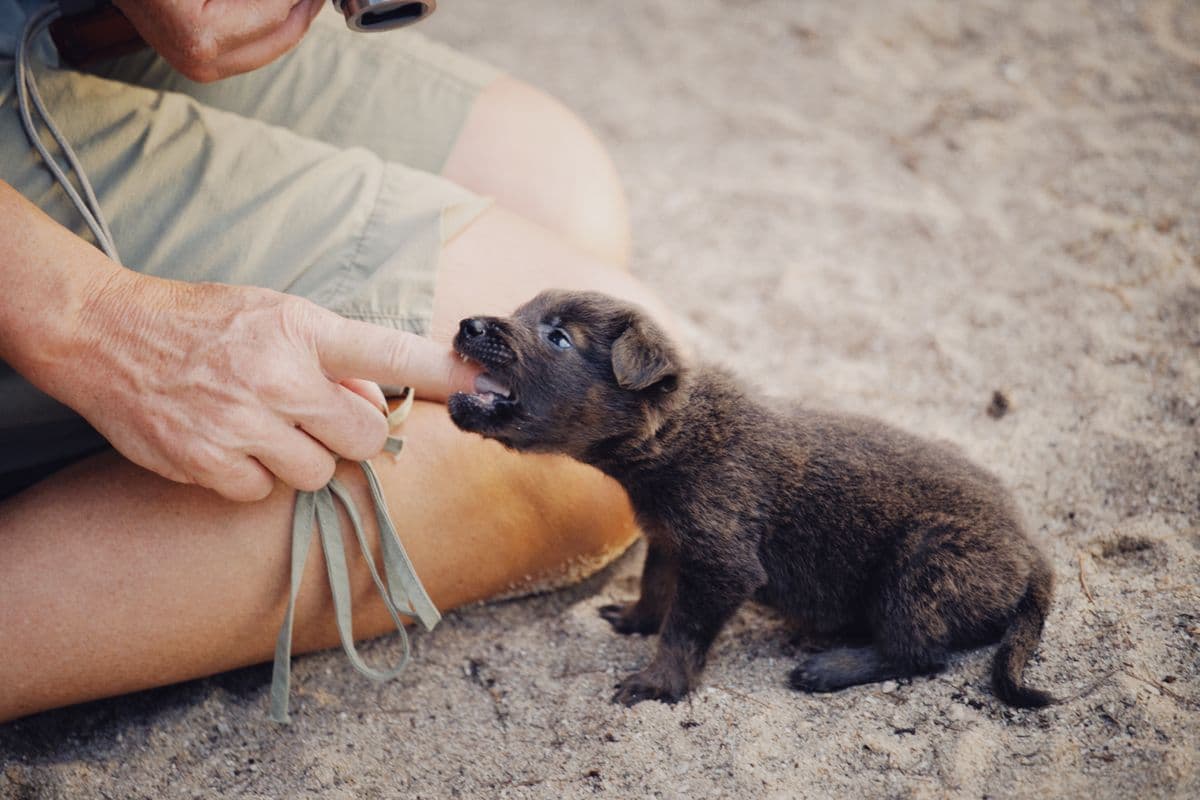
Chasing and nipping at moving feet is a normal dog behavior, and it's more strongly motivated in some dogs than others.1 It's often described as "herding," and in some breeds bred for herding work, that instinct can be part of it — but it isn't the only explanation. A certified trainer's professional read: ankle-nipping can also come from play, attention-seeking, or mild anxiety, not just herding drive.2 We won't tell you this is never anything to watch — but for the large majority of puppies doing this during normal excited movement, it's ordinary play behavior, not aggression.
What to Do While Walking
- Stop moving your feet the instant it starts. Movement is the trigger — removing it removes the game.
- Calmly disengage or redirect — bring out a toy (a tug toy dragged along the ground works well) rather than continuing to walk through it.
- Resume moving once your puppy has let go or engaged with the toy instead.
- If no toy is on hand, simply freezing and waiting for the mouthing to stop, then rewarding the calm moment, is a workable fallback.3
Freeze → Redirect → Resume
| Step | What You Do |
|---|---|
| Freeze | Stop all foot/leg movement the moment teeth touch |
| Redirect | Offer a toy at ground level, or simply wait calmly if none is on hand |
| Resume | Once your puppy disengages or takes the toy, start moving again calmly |
Want a full plan for this?
You have the core technique. Get a structured plan for the next step.
What Not to Do
- Don't keep walking through it — continued movement often turns your leg or pant cuff into an ongoing tug toy.
- Don't kick, push, or shove the puppy away with your foot — this can turn into another form of movement-based game, and it risks physically startling or hurting a small puppy.
- Don't chase or scold loudly — this adds more movement and excitement, which tends to escalate rather than resolve the behavior.
Pant-Leg Biting
The same principle applies to clothing grabs during walks: stop moving, wait for release or redirect to a toy, then resume. Continuing to walk while a puppy has hold of your pant leg reinforces exactly the behavior you're trying to reduce.
Managing This Around Children
Children's quick, high-pitched movement is a common trigger, and this is worth taking seriously for safety, not just annoyance. Teach children to go still ("freeze like a statue") rather than run or scream if a puppy starts nipping at their feet — movement and high energy from the child tend to escalate the behavior, while stillness tends to end it.4 Supervise puppy-child interactions closely regardless, since a young child usually can't execute this technique reliably on their own.
When It's More Than Play
Loose, bouncy movement with pauses and re-engagement attempts is typical play. Stiff body language, a hard stare, growling that isn't playful, or biting that seems to escalate rather than stop with the freeze technique are different signals and are worth a professional opinion — a certified trainer, behavior consultant, or veterinary behaviorist — rather than continuing to manage it alone.
Sources
- VCA Animal Hospitals, "Dog Behavior Problems – Chase Behaviors"
- Allie Bender, CPDT (Pet Harmony Animal Behavior & Training), quoted in Rover.com, "What To Do If Your Dog Nips at Ankles, According to Experts"
- ASPCA, "Mouthing, Nipping and Play Biting in Adult Dogs"
- VIN Veterinary Partner, "Mouthing and Play Biting in Puppies"